Articles
Spinal Stenosis After a Car Accident: What You Need to Know
Can a car accident aggravate spinal stenosis? Learn how crashes can worsen asymptomatic spinal conditions and why insurance companies often dispute these injury claims.
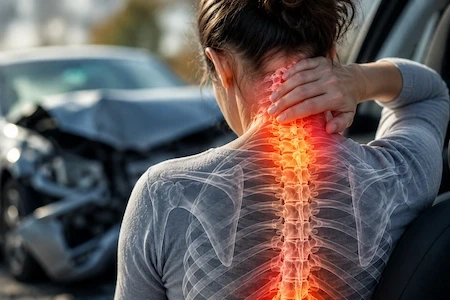
Spinal Stenosis After a Car Accident
Neck and back pain after a car accident is often dismissed by insurance companies as “just soreness” or “pre-existing degeneration.” But for many injured people, a collision can aggravate previously asymptomatic spinal stenosis, trigger new symptoms, or accelerate an underlying spinal condition that had never interfered with daily life before the crash.
At ACE Injury Attorneys, we frequently see insurance adjusters argue that spinal stenosis is purely age-related and unrelated to the collision itself. That argument is often overly simplistic and medically incomplete.
If you are experiencing radiating pain, numbness, weakness, tingling, balance problems, or worsening neck and back symptoms after a crash, it is important to understand how spinal stenosis can become symptomatic after trauma.
What Is Spinal Stenosis?
Spinal stenosis occurs when the spaces inside the spine narrow and place pressure on the spinal cord or surrounding nerves. The condition commonly affects the cervical spine (neck) and lumbar spine (lower back). Symptoms may include:
Neck pain
Back pain
Numbness or tingling
Weakness in the arms or legs
Radiating nerve pain
Balance issues
Difficulty walking
According to the Mayo Clinic’s overview of spinal stenosis, spinal stenosis can result from degenerative changes, disc injuries, thickened ligaments, bone spurs, or traumatic spinal injuries.
Can a Car Accident Cause or Aggravate Spinal Stenosis?
Yes.
A car accident may:
aggravate pre-existing but asymptomatic stenosis,
worsen already mild narrowing,
cause disc herniations that further compress the spinal canal,
or trigger symptoms that were never previously present.
Trauma from a collision can force the spine into unnatural motion, causing swelling, inflammation, disc injury, ligament damage, or instability that narrows the spinal canal further.
Importantly, many people have mild degenerative findings on MRI scans without any symptoms whatsoever. A person may function normally for years until a traumatic event causes the condition to become symptomatic.
This distinction matters enormously in injury claims.
Insurance Companies Often Argue Spinal Stenosis Is “Degenerative”
This is one of the most common defenses raised in neck and back injury claims.
Adjusters frequently point to MRI findings such as:
degenerative disc disease,
osteophytes,
arthritis,
foraminal narrowing,
or spinal stenosis
to argue the injured person was already “damaged” before the crash.
But that argument ignores an important medical and legal reality:
a person can have pre-existing degeneration and still suffer a serious aggravation injury from trauma.
A completely asymptomatic person who:
worked full-time,
exercised,
lifted weights,
drove comfortably,
and lived normally before the crash
may suddenly develop severe symptoms afterward because the collision aggravated the underlying condition.
That does not make the injury any less real.
Trauma Can Make Previously Asymptomatic Stenosis Symptomatic
This is a critical concept in car accident litigation.
Many spinal conditions exist silently for years until trauma causes:
nerve compression,
inflammation,
disc bulging,
instability,
or spinal cord irritation.
The American College of Rheumatology’s spinal stenosis overview, specifically notes that spinal injuries may contribute to spinal stenosis symptoms.
In other words:
the fact that degeneration existed before the crash does not mean the crash did not materially worsen the condition.
Common Symptoms After a Car Accident
Symptoms may appear:
immediately,
hours later,
or even days after the collision.
Common symptoms include:
neck stiffness
lower back pain
shooting arm pain
sciatica
numbness in the hands or feet
weakness
muscle spasms
headaches
balance problems
reduced range of motion
Some accident victims also experience worsening symptoms during:
prolonged sitting,
driving,
lifting,
bending,
or walking.
If you are experiencing these symptoms after a collision, consistent medical treatment becomes extremely important because medical treatment is the foundation of every injury claim.
MRI Findings Do Not Automatically Mean the Injury Is “Old”
One of the biggest misconceptions in injury claims is that degenerative MRI findings automatically defeat causation.
They do not.
In fact, it is extremely common for accident victims to discover previously asymptomatic conditions only after imaging is performed following trauma.
Insurance companies often attempt to weaponize phrases like:
“degenerative”
“pre-existing”
“chronic”
or “age-related”
But the real question is often:
Was the person functioning normally before the crash, and did the collision materially worsen the condition afterward?
That is a very different analysis.
Why Documentation Matters in Spinal Injury Claims
Spinal stenosis cases are heavily document-driven.
Medical records, imaging studies, prior treatment history, symptom progression, and physician opinions all matter significantly.
In many cases, documentation is the difference between a strong claim and a weak one.
It is also important to avoid treatment gaps whenever possible. Insurance companies frequently argue that delayed treatment means the injuries were unrelated to the collision. Learn more about the reasons why delaying medical treatment can hurt your case.
Treatment for Spinal Stenosis After a Crash
Treatment varies depending on:
symptom severity,
imaging findings,
nerve involvement,
and spinal stability.
Common treatments may include:
physical therapy,
injections,
pain management,
chiropractic care,
medication,
or surgery in severe cases.
The AICA Orthopedics overview of spinal stenosis after car accidents explains that traumatic collisions may aggravate spinal narrowing and require significant treatment depending on the severity of the injury.
Car Accidents Frequently Cause Serious Spine Injuries
Motor vehicle collisions remain a major cause of spinal trauma and spinal cord injuries.
Even relatively “minor” crashes can generate significant force through the cervical and lumbar spine, particularly in:
rear-end collisions,
high-speed impacts,
truck accidents,
and motorcycle accidents.
Learn more about our:
Contact a Rhode Island Car Accident Lawyer
If you developed neck pain, back pain, numbness, tingling, weakness, or worsening spinal stenosis symptoms after a collision, you should speak with an attorney before accepting an insurance company’s characterization of your injuries as merely “degenerative.”
At ACE Injury Attorneys, we represent accident victims throughout Rhode Island and Massachusetts and aggressively challenge attempts by insurance companies to minimize legitimate spinal injury claims.
Contact us today at 888-333-9833 for a free consultation.

1
Tell Us Your Story
Contact us for a FREE, no-obligation case review and explore your options.
2
We Get to Work
Once you hire us, we handle the legal process while you focus on recovery.
3
Get Compensated
We fight for maximum compensation and only get paid if we win your case.